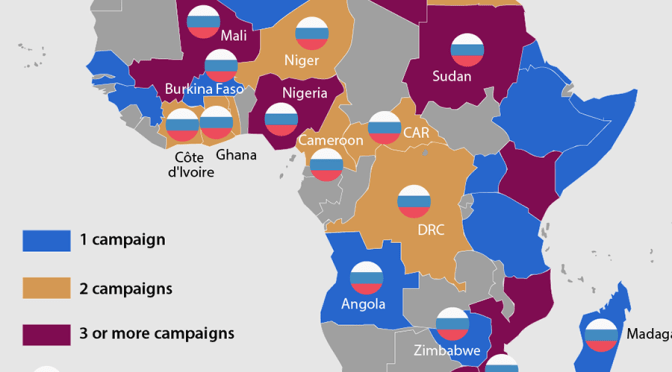
High-level Russian officials are meeting with Russian partners across Africa, seeking to advance the Kremlin’s strategic goals of projecting greater Russian influence to supplant the West and better positioning Russia for prolonged confrontation with the West.
The paragraph discusses Russia’s efforts to strengthen its military and economic presence in Africa, with a focus on advancing its strategic goals, projecting influence, and supplanting the West. It details high-level Russian officials’ visits to African countries, highlighting the intent to strengthen military cooperation, expand economic engagement, pursue nuclear energy and agricultural cooperation, and increase arms sales. Additionally, it covers Russia’s aim to gain political allies, mitigate Western isolation, and advance its narratives, as well as the formation of a pro-Russian bloc in the Alliance of Sahel States. The paragraph underscores Russia’s strategy to threaten NATO’s southern flank, degrade Western influence, and capitalize on new revenue streams and export markets in Africa.
I provided an overview of Russia’s strategic activities in Africa, including its efforts to strengthen military presence, expand economic engagement, pursue nuclear energy and agricultural cooperation, increase arms sales, gain political allies, and advance Russian narratives. The high-level visits by Russian officials to African countries and the potential impact of Somalia’s threat to expel Ethiopian forces were highlighted, emphasizing the multifaceted approach Russia is taking to bolster its influence and strategic positioning on the continent.
Recognize Somaliland as an independent nation in Africa
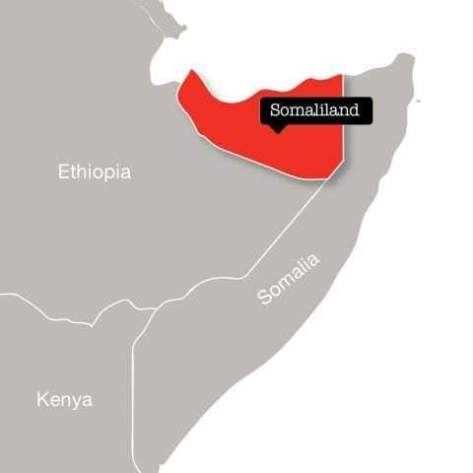
Somaliland is the newest country in Africa,
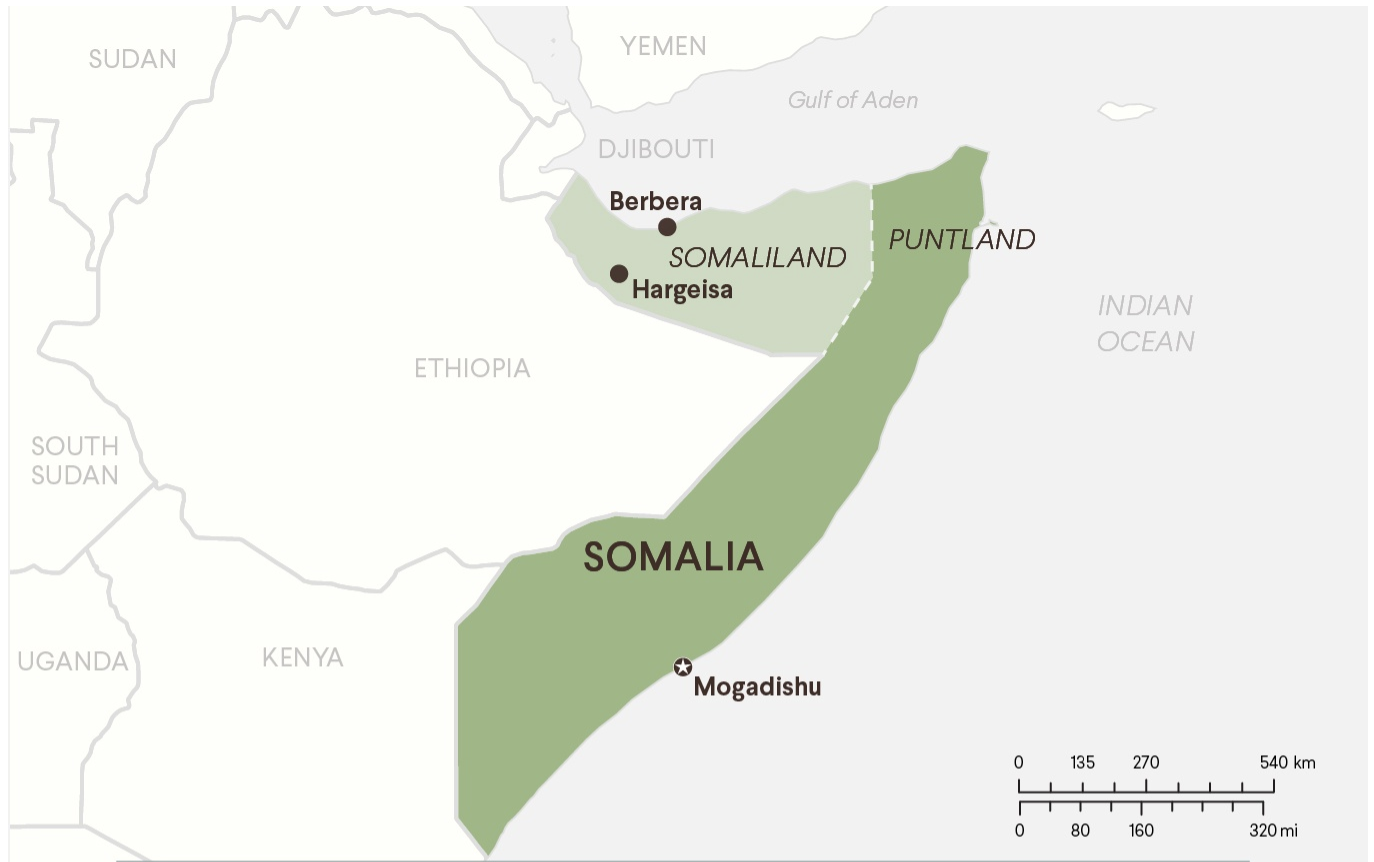
Somaliland, historically, the area now comprising Somalia and Djibouti. The name is also used to refer to the Republic of Somaliland, a self-declared independent country in the Horn of Africa
Rep. Ilhan Omar stated in a speech on Jan. 27 in Minneapolis that she would leverage her influence to block a potential agreement between Ethiopia and the breakaway Republic of Somaliland regarding access to the sea. In a corrected translation, Omar declared in Somali that “The U.S. government will do what we tell the U.S. government to do.”
That is the confidence we need to have as Somalis … As long as I’m in Congress, no one will take over the seas belonging to the nation of Somalia.”
The United States should carefully examine the prospect of recognizing Somaliland. 80 percent of the population is made up of the Isaaq clan, making it ethnically distinct from Somalia. Despite lack of international recognition, it has created a reasonably free and democratic society over the past 30 years, with presidential elections in 2003, 2010 and 2017, and is due to go to the polls again this November. International observers in 2017 noted that “Somaliland’s success in establishing a viable political system that combines customary structures with the representative electoral mechanisms of the nation-state has been impressive.”
Somaliland still faces challenges of corruption, economic and political marginalization, and violence against women. But over the same 33-year period, Somalia, which asserts its sovereignty, has been in freefall, beset by internal violence and weak political institutions.
Freedom House, which produces an annual assessment of political freedoms and civil liberties, last year rated Somaliland as “partly free” with a score of 44 out of 100. Somalia was declared “unfree” with just 8 of 100. For context, the United States only managed 76 of 100.
President Joe Biden should take advantage of a diplomatic opportunity for security and stability in the Horn of Africa, despite concerns about Islamic sentiment. Somalia is often associated with the 1993 Battle of Mogadishu depicted in the film “Black Hawk Down,” and American forces have been intermittently present in the country for over 30 years. The official American policy supports Somalia’s sovereignty and territorial integrity within its 1960 borders, but there is potential for policy change. The Republic of Somaliland declared independence from the central government in 1991, and even though the territory seeking autonomy has a complex colonial history, there is an opportunity for reconsideration of its status.
determined group of legislators campaigning for recognition of Somaliland. Britain’s support for Operation Prosperity Guardian and military action against the Houthis suggests an obvious partnership: change tack, support indigenous economic development and show the region a new model of stepping up to self-sufficiency and the West’s enthusiasm to embrace vibrant nations as part of the security architecture. Success is by no means guaranteed — but the approach of the past 30 years has shown itself exhaustively to be a failure.Eliot Wilson is a freelance writer on politics and international affairs. He was senior official in the U.K. House of Commons from 2005 to 2016, including serving as a clerk of the Defence Committee and secretary of the U.K. delegation to the NATO Parliamentary Assembly.
Country music has a rich history that reflects the development of Africa, stemming from traditional African sounds and expanding into diverse subgenres that continue to enthrall audiences. Additionally, it’s common to experience homesickness upon returning from breaks, signifying a strong attachment to loved ones, and the process of adjusting to a new environment may take some time.
Is it right to leave your country?What is one song from your country that makes you emotional and why?
I am a refugee, I lost my country, I lost my small house, I lost my father and mother, brother and sisters (Repeat lyrics)
No guns, no fight,
We need life with peace,
No guns, no fight,
We need life with peace,
We don’t need more war,
We don’t need more deaths,
We don’t need more war,
We don’t need more deaths
I am dreaming like everyone in the world
I am dreaming like everyone in the world
To be a human, living a good life (Repeat lyrics)
I am dreaming like everyone in the world
I am dreaming like everyone in the world,
To be a human, living a good life,
We are Somalis,
We are Africans By: Somali Artist Shakir Essa
Is it right to leave your country?
Everyone has the right to leave any country, including his own, and to return to his country.”1 In accordance with UN human rights practices, the Declaration was given specific form.
What country is not allowed to leave? North Korea North Korea is just about the only country that forbids most people from leaving. Why do you miss your home country so much? Being in a new place and missing your home, family, friends, and pets, is completely normal. It means that you have a healthy attachment to your loved ones. It will take a while to adjust to your new
This can be caused by missing family and friends, feeling isolated in an unfamiliar environment, or struggling to adjust to your academic workload. It is also normal to feel homesick in the weeks following the Christmas and Easter breaks after spending time back home.
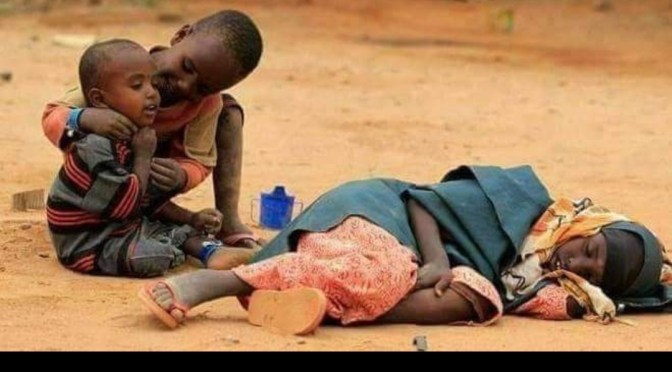
Listen to this emotional song: I’m Refuge I lost my country, by Somali Artist Shakir Essa
Listen to: I am a refugee, I lost my country,I lost my small house,I lost my father and mother, brother and sisters(
I am a refugee, I lost my country,
I lost my small house,
I lost my father and mother, brother and sisters
(Repeat lyrics)
No guns, no fight,
We need life with peace,
No guns, no fight,
We need life with peace,
We don't need more war,
We don't need more deaths,
We don't need more war,
We don't need more deaths

I am dreaming like everyone in the world
I am dreaming like everyone in the world
To be a human, living a good life
(Repeat lyrics)
I am dreaming like everyone in the world
I am dreaming like everyone in the world,
To be a human, living a good life,
We are Somalis,
We are Africans
“Refuge” by Shakir Essa really dives deep into the whole losing-your-homeland thing. It’s like a rollercoaster of emotions for refugees, you know?
Seeking stability, yearning for a place to call home – it’s a real emotional ride. But hey, it’s also a reminder that we all just want a little security and a spot to chill, right? So yeah, “Refuge” is all about showing that human spirit can power through some tough times and keep on reaching for hope.
The song’s lyrics encapsulate the struggles of a refugee’s journey, bringing a powerful reminder of the universal desire for a place to belong. It’s like, “Hey, we’re all in this crazy world together, trying to find our place, you know?” The emotions in the song really hit hard and show the strength that comes from enduring tough times. It’s like the human spirit saying, “Hey, I got this. I can handle whatever life throws at me.”
So, when you listen to “Refuge”, it’s not just a song – it’s a whole vibe, a feeling that resonates with anyone who’s been through tough times and come out stronger. It’s like a musical hug saying, “You got this. You’re stronger than you think.” And that’s pretty awesome, right?
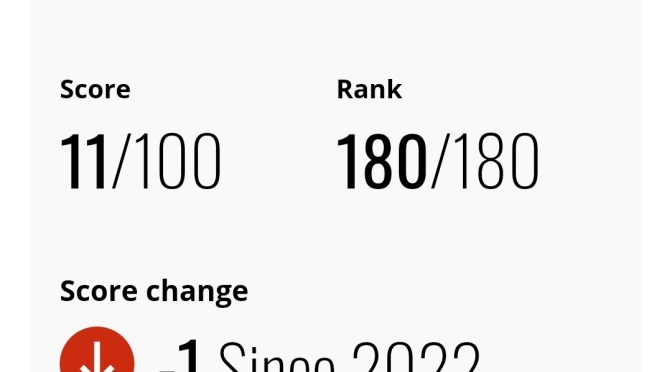
Scoring 180 countries around the world, the Corruption Perceptions Index is the leading global indicator of public sector corruption. Somalia has a score of 11 this year, with a change of -1 since last year, meaning it ranks 180 out of 180 countries.
Top 20 Safest Countries in Africa. Tanzania. …Botswana. …Kenya. ..Somaliland..Uganda. …Namibia. …Zambia. …Mauritius. Mauritius, a beautiful island in Africa, is a safe haven for travelers. …Lesotho. Lesotho, a tiny country surrounded by South Africa and mountains, is a great destination for travelers seeking safe places in Africa.
David Pilling is the Africa editor and a columnist at the Financial Times. He covers business, politics and development on the continent and writes a regular column on topics from Africa. Before that he was the Asia editor and assistant editor. Previous roles include Tokyo bureau chief, pharmaceuticals correspondent, deputy features editor and correspondent in Buenos Aires and Santiago.He is the author of two books – The Growth Delusion (2018), shortlisted for the Orwell Prize, and the highly acclaimed Bending Adversity: Japan and the Art of Survival (2016).He is a regular moderator and speaker both for the FT and for organisations including the World Bank, OECD and ADB. In 2023 he briefed a G7 meeting in Kamakura, Japan on the ideas behind his book,
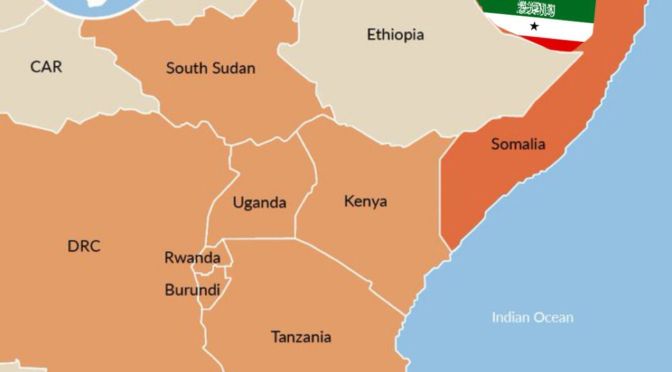
Ethiopia to recognize Republic of Somaliland for sea accessThe federal government is reportedly willing to become the first African nation to recognize the sovereignty of the Republic of Somaliland, a breakaway Somali territory, in exchange for a lease on a 20 kilometer stretch of the Somaliland coast and access to Berbera Port.Stakes in state-owned Ethiopian Airlines and Ethio telecom are also on the table in the Somaliland deal, according to Ambassador Redwan Hussein, security advisor to the Prime Minister.An MoU signed with Somaliland President Muse Bihi will also enable Ethiopia to operate a military base and commercial port in Somaliland, according to Redwan.
The agreement would include Ethiopia’s eventual recognition of Somaliland as an independent nation. Somalia considers
Monday’s surprise pact has triggered fury in Mogadishu, which considers it a violation of its sovereignty.It was announced only days after Somalia’s central government had agreed to resume dialogue with the separatist northern region after years of stalemate.
Somaliland has been seeking full statehood since claiming independence from Somalia in 1991, a move fiercely opposed by Mogadishu and not recognised internationally. The Addis Ababa agreement gives landlocked Ethiopia long-desired access to the Red Sea, a key waterway for global trade.”This historic agreement ensures Ethiopia’s access to the Red Sea for their naval forces, reciprocated by formal recognition of the Republic of Somaliland, marking this as a significant diplomatic milestone for our country,” Somaliland’s foreign ministry said in a statement.Somali National Television said on X, formerly Twitter, that there would an emergency cabinet meeting on Tuesday to discuss the agreement.
There has been no immediate reaction from President Hassan Sheikh Mohamud’s office, but his predecessor Mohamed Abdullahi Mohamed, better known as Farmajo, said on X it was a “serious concern for Somalia and the whole of Africa
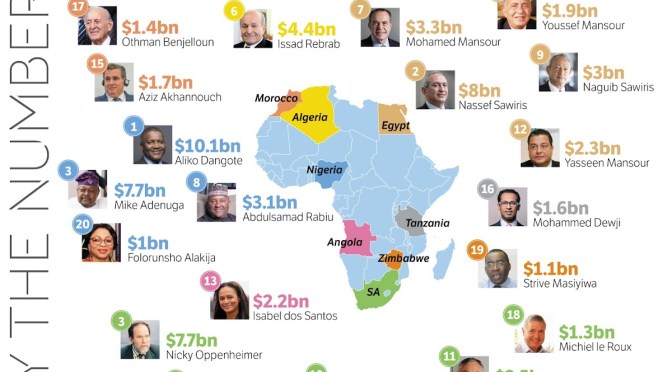
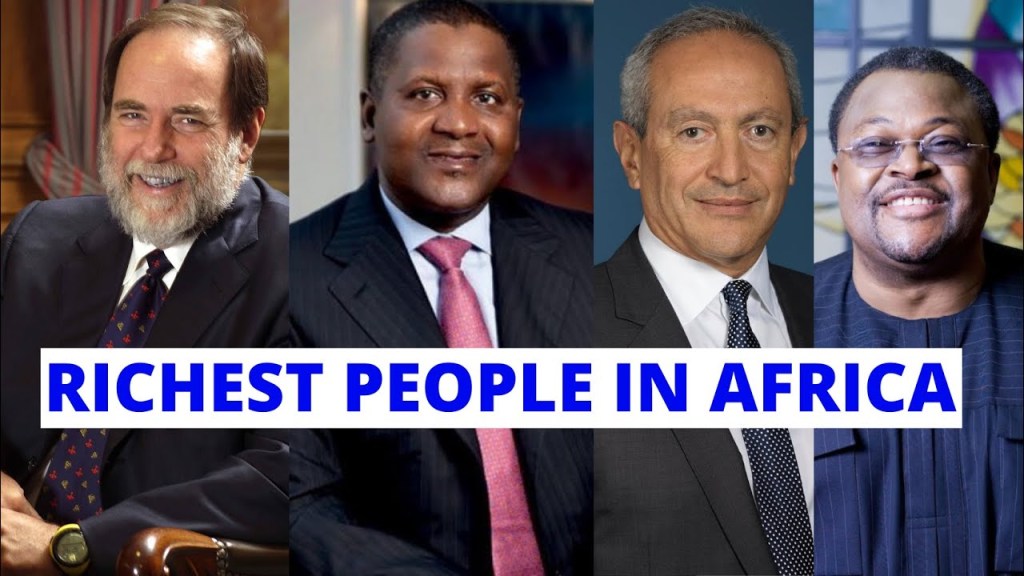
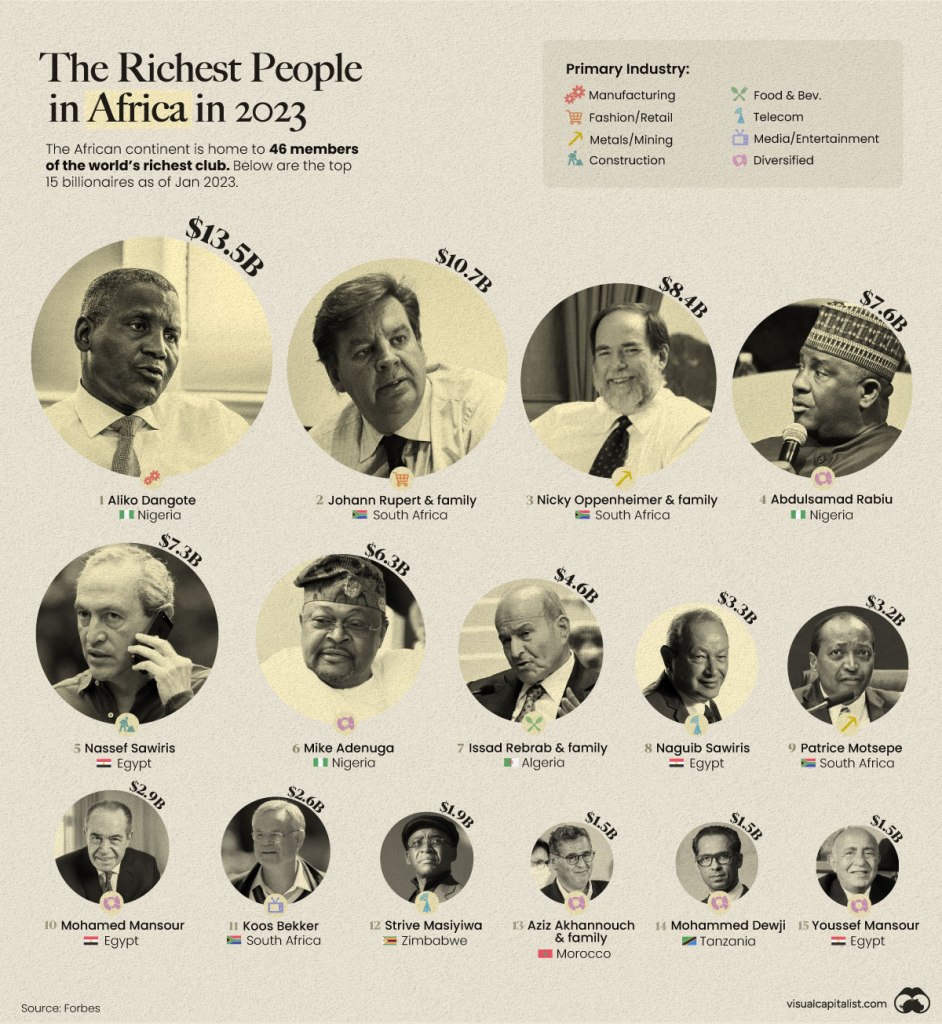
This graphic ranks the richest people in Africa. Aliko Dangote from Nigeria leads the group.
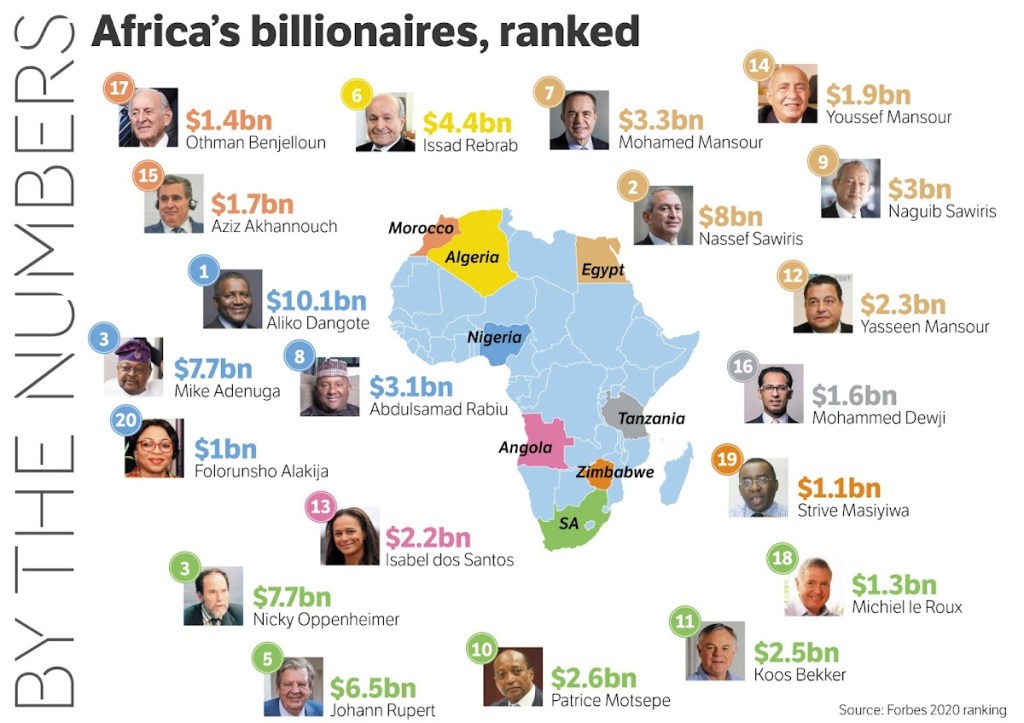
Ranked: Who Are the Richest People in Africa? The African continent is home to 46 billionaires, the second-lowest total of any global region.
The number of wealthy individuals in Africa is growing, however. Total private wealth is expected to rise 30% over the next decade, led by growth in the billionaire and millionaire segments.
Visualized here are Africa’s richest, using data collected by Forbes, on billionaires who reside on the continent and have their primary business there.
Breaking Down Africa’s Billionaires The richest man in Africa is also the richest Black man in the world. Once a small sugar trader, Aliko Dangote now has a net worth of $13.5 billion. He is the 86th richest person in the world, and single-handedly makes up 25% of the total wealth of African billionaires.
His company, the Dangote Group is now an African conglomerate with interests in a range of sectors, including sugar, cement, and real estate.
Rank Name Net Worth (billions, USD) Industry Citizenship 1 Aliko Dangote $13.5 Manufacturing 🇳🇬 Nigeria 2 Johann Rupert & family $10.7 Fashion & Retail 🇿🇦 South Africa 3 Nicky Oppenheimer & family $8.4 Metals & mining 🇿🇦 South Africa 4 Abdulsamad Rabiu $7.6 Diversified 🇳🇬 Nigeria 5 Nassef Sawiris $7.3 Construction & Engineering 🇪🇬 Egypt 6 Mike Adenuga $6.3 Diversified 🇳🇬 Nigeria 7 Issad Rebrab & family $4.6 Food & Beverage 🇩🇿 Algeria 8 Naguib Sawiris $3.3 Telecom 🇪🇬 Egypt 9 Patrice Motsepe $3.2 Metals & mining 🇿🇦 South Africa 10 Mohamed Mansour $2.9 Diversified 🇪🇬 Egypt 11 Koos Bekker $2.6 Media & Entertainment 🇿🇦 South Africa 12 Strive Masiyiwa $1.9 Telecom 🇿🇼 Zimbabwe 13 Mohammed Dewji $1.5 Diversified 🇹🇿 Tanzania 13 Aziz Akhannouch & family $1.5 Diversified 🇲🇦 Morocco 13 Youssef Mansour $1.5 Diversified 🇪🇬 Egypt The top three—Alike Dangote, Johann Rupert, and Nicky Oppenheimer—account for 40% of the total wealth of those ranked.
A Look Through the Rest of the Richest People in Africa At number two on the list is Johann Rupert. The chairman of Swiss luxury goods company, Compagnie Financiere Richemont, started his career with a banking apprenticeship in New York, before returning to South Africa and eventually pivoting to retail.
Through the rest of those ranked, a range of diverse business activities have allowed these billionaires to garner their wealth.
Nicky Oppenheimer (3rd) and Patrice Motsepe (9th)—have made fortunes in the mining industry, a sector that contributes nearly 10% to sub-Saharan Africa’s GDP. Meanwhile, Naguib Sawiris (8th) and Strive Masiyiwa (12th) have built telecom empires.
Billionaire Wealth Mirrors Country Wealth Only seven out of the 54 African countries are represented on Africa’s rich list, and even amongst them, three countries (Egypt, South Africa, and Nigeria) account for more than two-thirds of the top-ranked billionaires.
Country Rank in African Economy Individuals on Top 15 Billionaire List 🇳🇬 Nigeria #1 3 🇿🇦 South Africa #2 4 🇪🇬 Egypt #3 4
Ranked: Who Are the Richest People in Africa?
The home countries for these billionaires reflect the nation’s’ contribution to the African economy as a whole. Nigeria, South Africa, and Egypt have the top three GDPs in Africa.
Algeria—where Issad Rebrab (7th) is from—is ranked fourth, and Morocco—where Aziz Akhannouch (13th) is based—is fifth.
What’s Next For Africa’s Richest? Africa has routinely been touted to become a future economic powerhouse as its demographic dividend pays off in the next few decades. However, its biggest challenge will be developing its economic and social infrastructure to retain local talent to make their fortunes at home.
African Billionaires
WEALTH Ranked: Who Are the Richest People in Africa? Published on July 18, 2023 By Shakir Essa
Mapping Africa’s Wealth The Chart of the Week is a weekly Visual Capitalist feature on Fridays.
The economy in Africa is on the rise, and financial hubs are beginning to emerge.
While the resource-rich African continent has seen only 13% growth in total private wealth over the past 10 years, the 3% spike in the past year alone indicates the growth is just warming up. Africa will also be home to 13 out of the 20 of the world’s largest megacities by 2100.
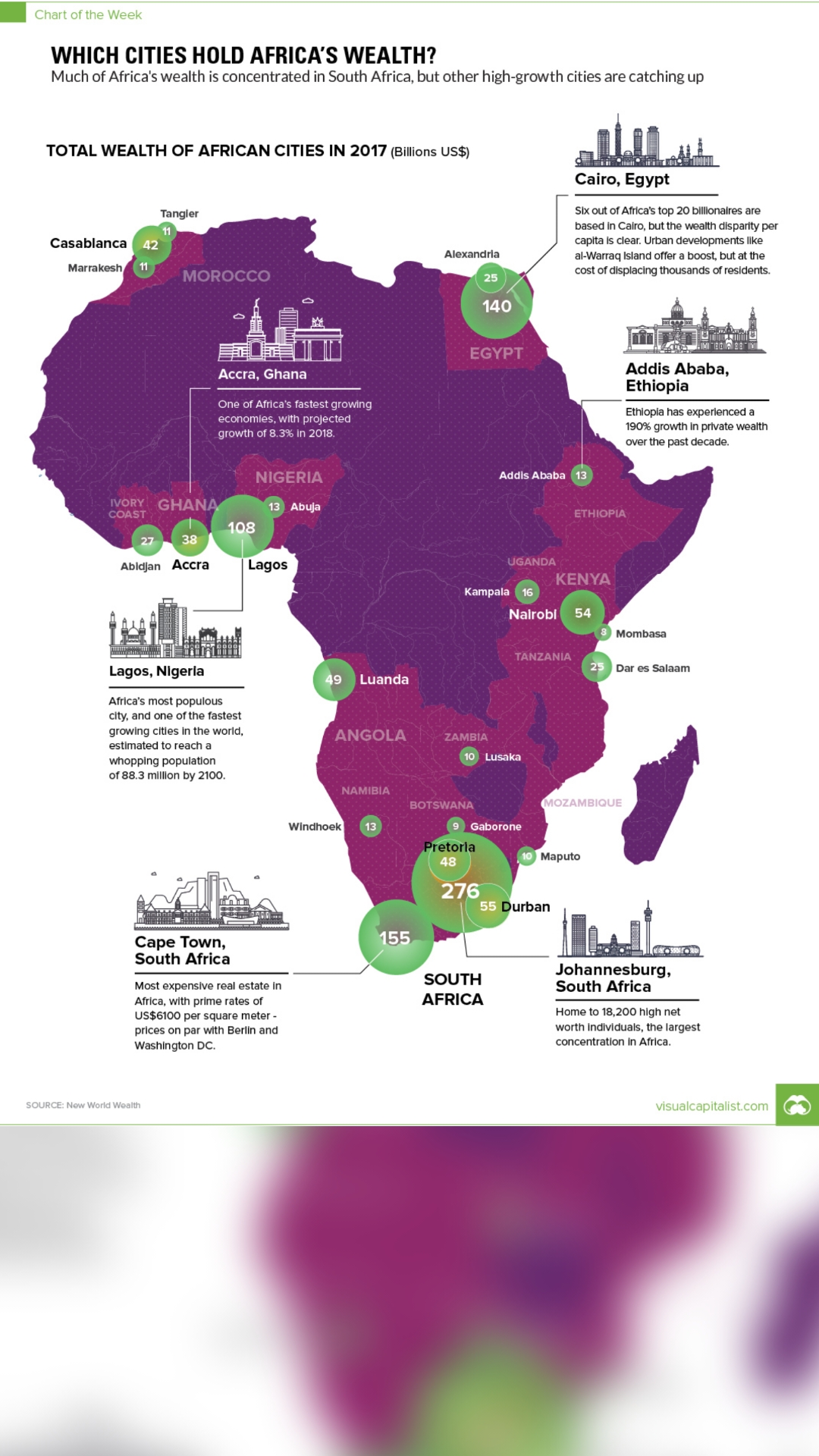
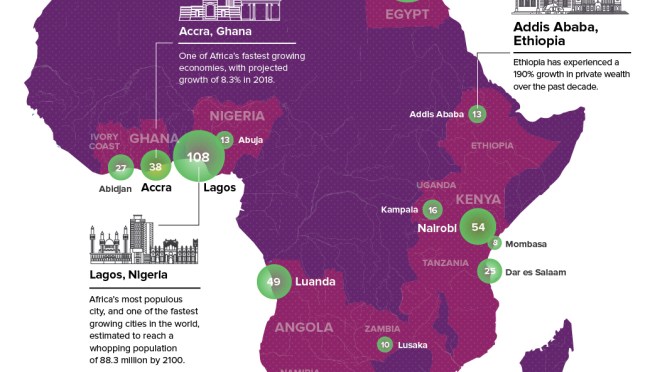
In this week’s chart, we take a look at Africa’s wealthiest cities, courtesy of this recent 2018 report from New World Wealth and AfrAsia Bank.
Africa’s Evolving Economy While Africa has traditionally played a minor role in the world market, the continent is coming into its own as a hub for financial services and entrepreneurship.
Africa’s growing elite has added 19,000 millionaires over the past decade, with total private wealth totaling $2.3 trillion. These figures are predicted to increase by 34% over the next decade, reaching $3.1 trillion by the end of 2027.
The five wealthiest cities hail from three countries:
1. Johannesburg, South Africa ($276 billion) Founded in the Witwatersrand Gold Rush of 1886, South Africa’s City of Gold is a hub for financial services, professional services (law firms and consultancies), construction, telecommunications, and basic materials.
2. Cape Town, South Africa ($155 billion) One of South Africa’s three capital cities, Cape Town’s major sectors include real estate, financial services, retail, and tourism. Cape Town has the highest prime residential rates on the continent at US$6,100 per square meter, similar to cities such as Washington, D.C., or Berlin.
3. Cairo, Egypt ($140 billion) A hub for Africa and the Middle East, Cairo’s major sectors include real estate, construction, financial services, and basic materials.
4. Lagos, Nigeria ($108 billion) The clearing house for 80% of Nigeria’s imports, major sectors include basic materials, real estate, construction, telecommunications, transport, and financial services.
5. Durban, South Africa ($55 billion) Home to the biggest shopping center in Africa – complete with 350 stores, 70 restaurants, 18 movie theaters, an IMAX theater, an indoor climbing wall, and a skate park designed by Tony Hawk – Durban’s major sectors include real estate, finance, healthcare, construction, retail, and transport.
The Full List of Cities Here is a full ranking of the top 23 cities in Africa, based on New World Wealth’s data.
Rank City Country Total Private Wealth (USD) #1 Johannesburg South Africa $276 billion #2 Cape Town South Africa $155 billion #3 Cairo Egypt $140 billion #4 Lagos Nigeria $108 billion #5 Durban South Africa $55 billion #6 Nairobi Kenya $54 billion #7 Luanda Angola $49 billion #8 Pretoria South Africa $48 billion #9 Casablanca Morocco $42 billion #10 Accra Ghana $38 billion #11 Abidjan Côte d’Ivoire $27 billion #12 Dar es Salaam Tanzania $25 billion #13 Alexandria Egypt $25 billion #14 Kampala Uganda $16 billion #15 Windhoek Namibia $13 billion #16 Abuja Nigeria $13 billion #17 Addis Ababa Ethiopia $13 billion #18 Marrakesh Morocco $11 billion #19 Tangier Morocco $11 billion #20 Lusaka Zambia $10 billion #21 Maputo Mozambique $10 billion #22 Gaborone Botswana $9 billion #23 Mombasa Kenya $8 billion With a growth trajectory on the rise and renewed interest in African investment, what will Africa’s economy look like ten years from now?
The Most Corrupt Countries and the least Corrupt countries in the world,
The most Corrupt countries and the least corrupt countries
Mapped: Corruption in Countries Around the World Mapped: Corruption in Countries Around the World How bad is public sector corruption around the world, and how do different countries compare?
No matter your system of government, the public sector plays a vital role in establishing your economic mobility and political freedoms. Measuring corruption—the abuse of power for private gain—reveals how equal a system truly is.
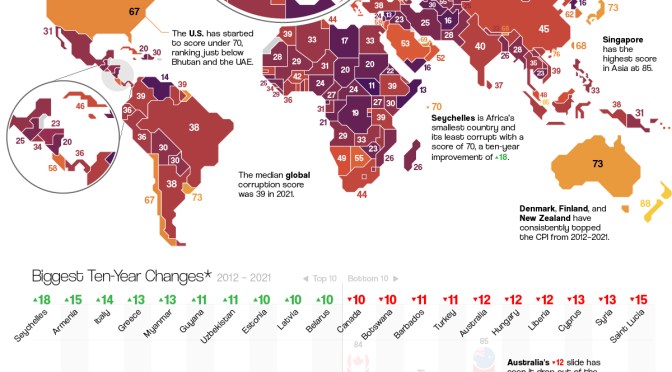
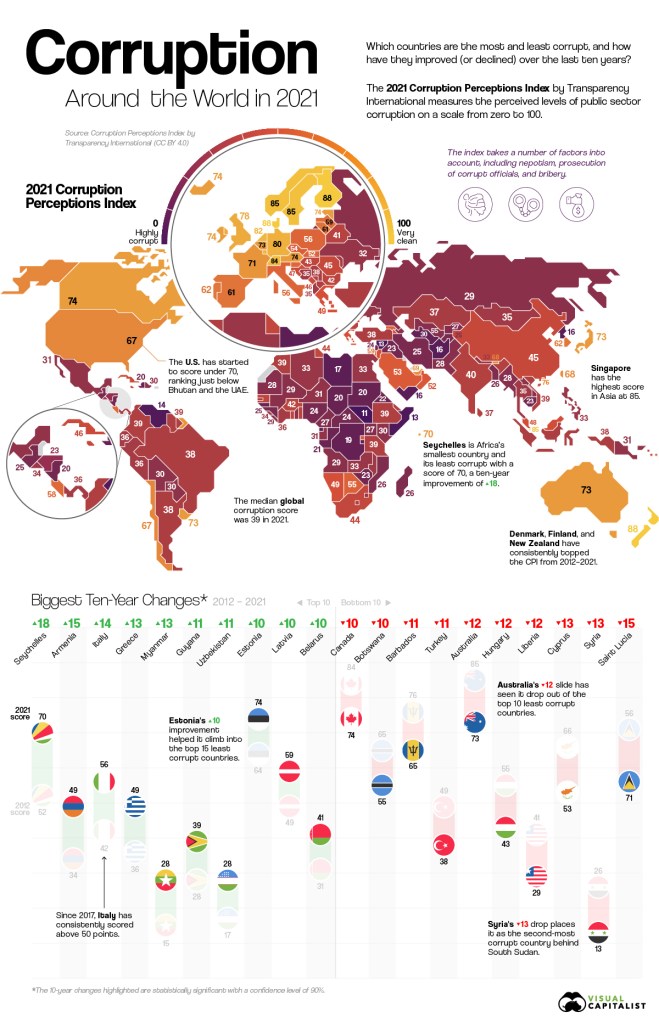
For more than a decade, the Corruption Perceptions Index (CPI) by Transparency International has been the world’s most widely-used metric for scoring corruption. This infographic uses the 2021 CPI to visualize corruption in countries around the world, and the biggest 10-year changes.
Which Countries are Most (and Least) Corrupt? How do you measure corruption, which includes behind-the-scenes deals, nepotism, corrupt prosecution, and bribery?
Over the last few decades, the CPI has found success doing so indirectly through perceptions. By aggregating multiple analyses from country and business experts, the index assigns each country a score on a scale of 0 to 100, where 0 is highly corrupt and 100 is very clean.
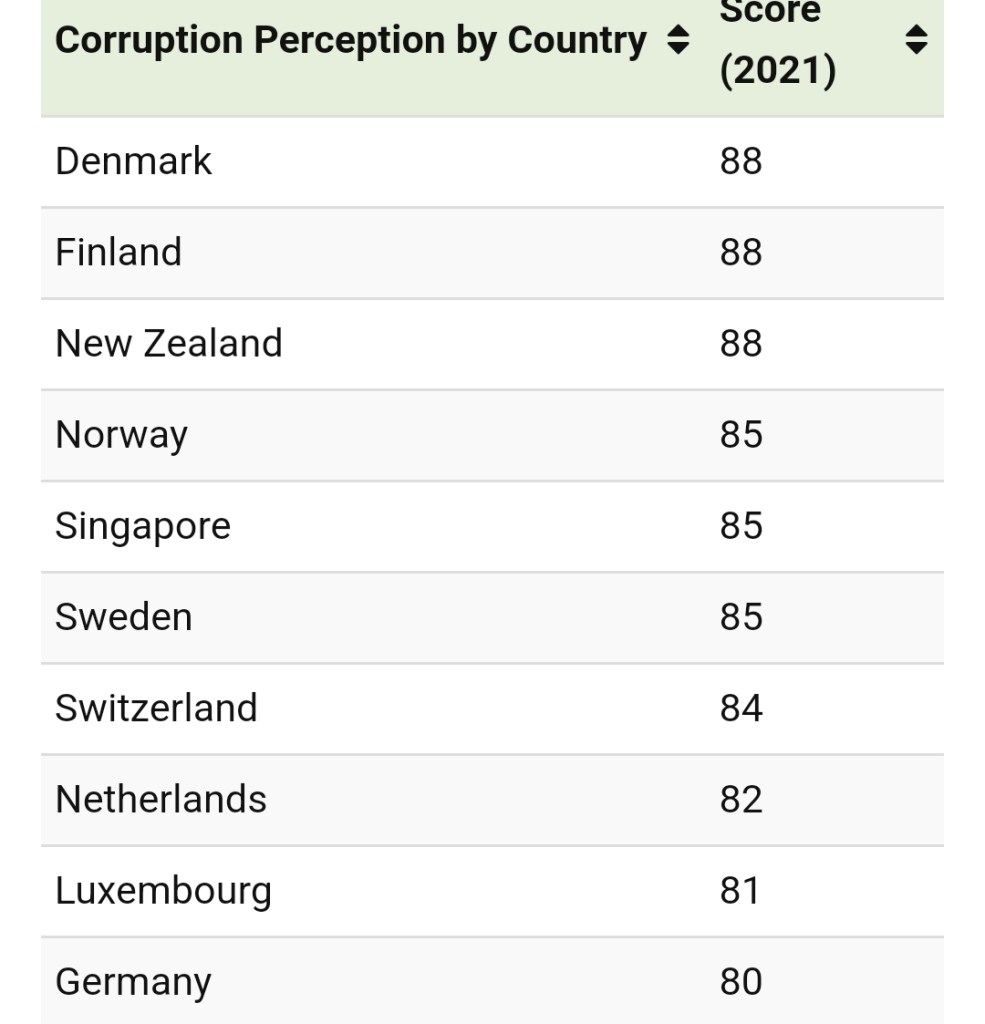
Here are the results of the 2021 CPI, with the least corrupt countries at the top:
Search: Corruption Perception by Country Score (2021) Denmark 88 Finland 88 New Zealand 88 Norway 85 Singapore 85 Sweden 85 Switzerland 84 Netherlands 82 Luxembourg 81 Germany 80 Showing 1 to 10 of 180
Mapping: the Corruption in Countries Around the World
Ranking at the top of the index with scores of 88 are Nordic countries Denmark and Finland, as well as New Zealand.
They’ve consistently topped the CPI over the last decade, and Europe in general had 14 of the top 20 least corrupt countries. Asia also had many notable entrants, including Singapore (tied for #4), Hong Kong (#12), and Japan (tied for #18).
Comparatively, the Americas only had two countries score in the top 20 least corrupt: Canada (tied for #13) and Uruguay (tied for #18). With a score of 67, the U.S. scored at #28 just behind Bhutan, the UAE, and France.
Scoring towards the bottom of the index were many countries currently and historically going through conflict, primarily located in the Middle East and Africa. They include Afghanistan, Venezuela, Somalia, and South Sudan. The latter country finishes at the very bottom of the list, with a score of just 11.
How Corruption in Countries Has Changed (2012–2021) Corruption is a constant and moving global problem, so it’s also important to measure which countries have had their images improved (or worsened).
By using CPI scores dating back to 2012, we can examine how country scores have changed over the last decade:
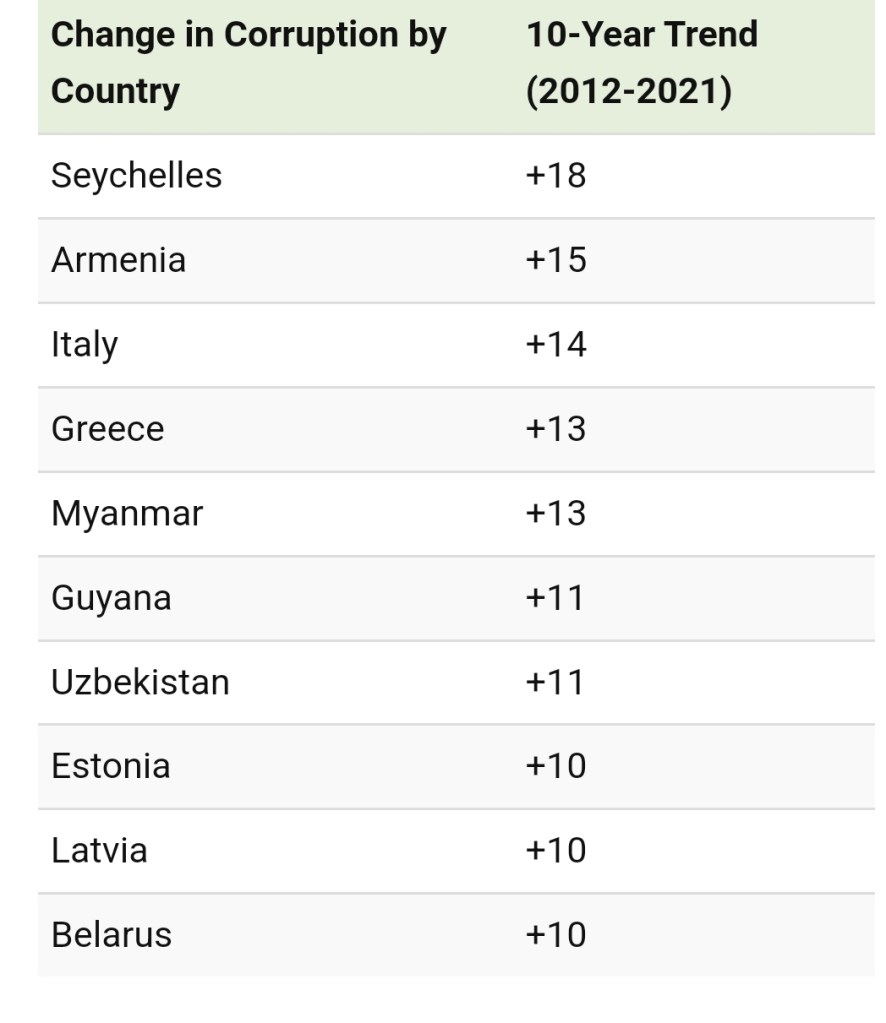
Search: Change in Corruption by Country 10-Year Trend (2012-2021) Seychelles +18 Armenia +15 Italy +14 Greece +13 Myanmar +13 Guyana +11 Uzbekistan +11 Estonia +10 Latvia +10 Belarus +10
The biggest climber with +18 was Seychelles, Africa’s smallest country and also its least corrupt with a score of 70. Other notable improvements include neighboring countries Estonia, Latvia, and Belarus, with Estonia rising into the top 15 least corrupt countries.
On the opposite side, both Australia (-12) and Canada (-10) have actually fallen out of the top 10 least corrupt countries over the last decade. They’re joined by decreases in Hungary (-12) and Syria (-13), which is now ranked as the world’s second-most corrupt country.
Which countries will rise and fall in corruption perceptions over the next 10 years, and how do your perceptions compare with this list?
Country age demographics are determined by two key factors: fertility and mortality.
Throughout history, it was typical to see both birth and death rates at higher levels. But today, in most parts of the world, women are having fewer children, and innovations in healthcare and technology mean we are all living longer. The average person today lives to 72.6 years old, while the rate of births per woman has fallen to 2.5.
These trends have drastically altered the demographics of mature economies, resulting in a much older population. In many developing countries, however, births still outweigh deaths, resulting in populations that skew younger.
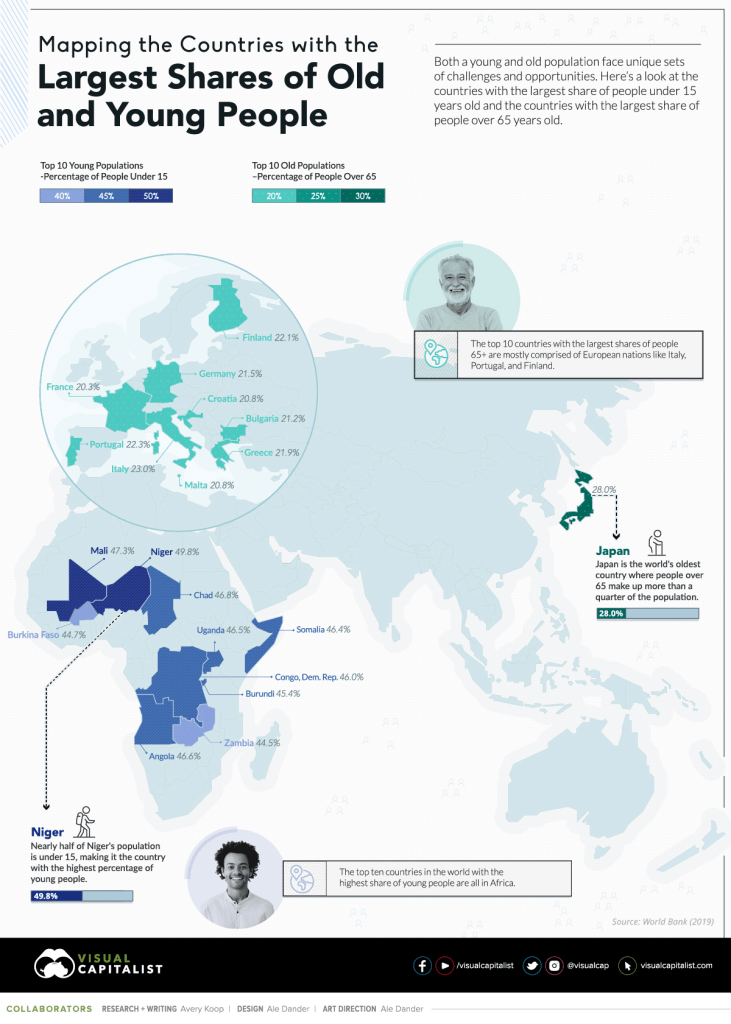
This visualization uses data from the World Bank to examine the countries with the highest shares of old and young people.
The Fountain of Youth By 2030, the United Nations estimates there will be 1.3 billion people on the planet between the ages of 15-24. Proving to be a fountain of youth globally, the continent of Africa boasts the top 10 countries with the largest shares of young people in the world.
Somalia, Zambia, and the DRC are just a few to crack the top 10 list. The youngest country in the world is Niger, where almost 50% of the population is below the age of 15.
Here’s a full list of global countries, sorted by percentage of population under 15 years old: Search: Country Share of Population Younger Than 15 (% of total, 2019) 🇳🇪 Niger 49.8% 🇲🇱 Mali 47.3% 🇹🇩 Chad 46.8% 🇦🇴 Angola 46.6% 🇺🇬 Uganda 46.5% 🇸🇴 Somalia 46.4% 🇨🇩 Congo, Dem. Rep. 46.0% 🇧🇮 Burundi 45.4% 🇧🇫 Burkina Faso 44.7% 🇿🇲 Zambia 44.5% Showing 1 to 10 of 191 entriesPreviousNext Young countries have significant opportunities ahead of them. A younger population means a larger upcoming workforce and more opportunities for innovation and economic growth.
While domestic markets in Africa grow in terms of labor supply, innovation, and potential consumers, there are also challenges that arise in these countries. Corruption, political instability and unemployment, particularly in Africa, are all potential barriers to prosperity for the continent’s Gen Z population.
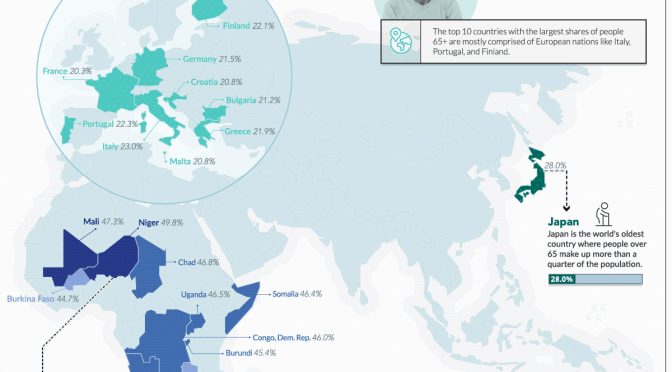
Populations Skewing Older The world’s oldest country is Japan, where 28% of the population is older than 65. However, it’s an anomaly—the rest of the oldest countries in the top 10 are all in Europe.
Globally, it’s the 65+ age group that is growing the fastest. According to the same UN estimates, it is predicted that by 2050 that one in six people will be over 65 years old.
Here’s a full list of global countries, sorted by percentage of population over 65 years old:
Search: Country Share of Population Older Than 65 (% of total, 2019) 🇯🇵 Japan 28.0% 🇮🇹 Italy 23.0% 🇵🇹 Portugal 22.4% 🇫🇮 Finland 22.1% 🇬🇷 Greece 21.9% 🇩🇪 Germany 21.5% 🇧🇬 Bulgaria 21.2% 🇭🇷 Croatia 20.8% 🇲🇹 Malta 20.8% 🇫🇷 France 20.3% Showing 1 to 10 of 192 entriesPreviousNext Fewer births, and a resulting older population, is a trend attributed to the changing lifestyles of women. For example, Japan’s fertility rate has fallen to less than 1.5 children per woman due to modern access to contraceptives and the prioritization of work over marriage and family life.
However, fewer young people also means a smaller workforce on the horizon and a shrinking domestic market. There is also a rising social cost of caring for the elderly, as longer lifespans have resulted in a higher prevalence of chronic diseases and an increasing inability to care for oneself. This can result in an increased tax burden on the diminishing younger, working population.
Another Perspective on the Data Looking at the data from the opposite angle also reveals information about our world. Here’s a look at the countries with the lowest proportions of younger or older people.
youngest and oldest countries
Hong Kong and Singapore have some of the lowest fertility rates in the world (1.1), so it’s no surprise to see low numbers of children in their demographic data.
In a country like the United Arab Emirates, the majority of the population is made up of foreign workers, so the number of people in the 65+ age group is extremely low. In the coming decades though, the situation is expected to shift dramatically with one in every five Emiratis residing that age group by 2050.
The Big Picture While each country has its own unique demographic make up, one thing is clear. As education and wealth levels rise around the world, fertility rates are dropping almost everywhere.
The trend of long life expectancies and fewer births is likely to continue, but young outliers will remain and they present immense economic potential.
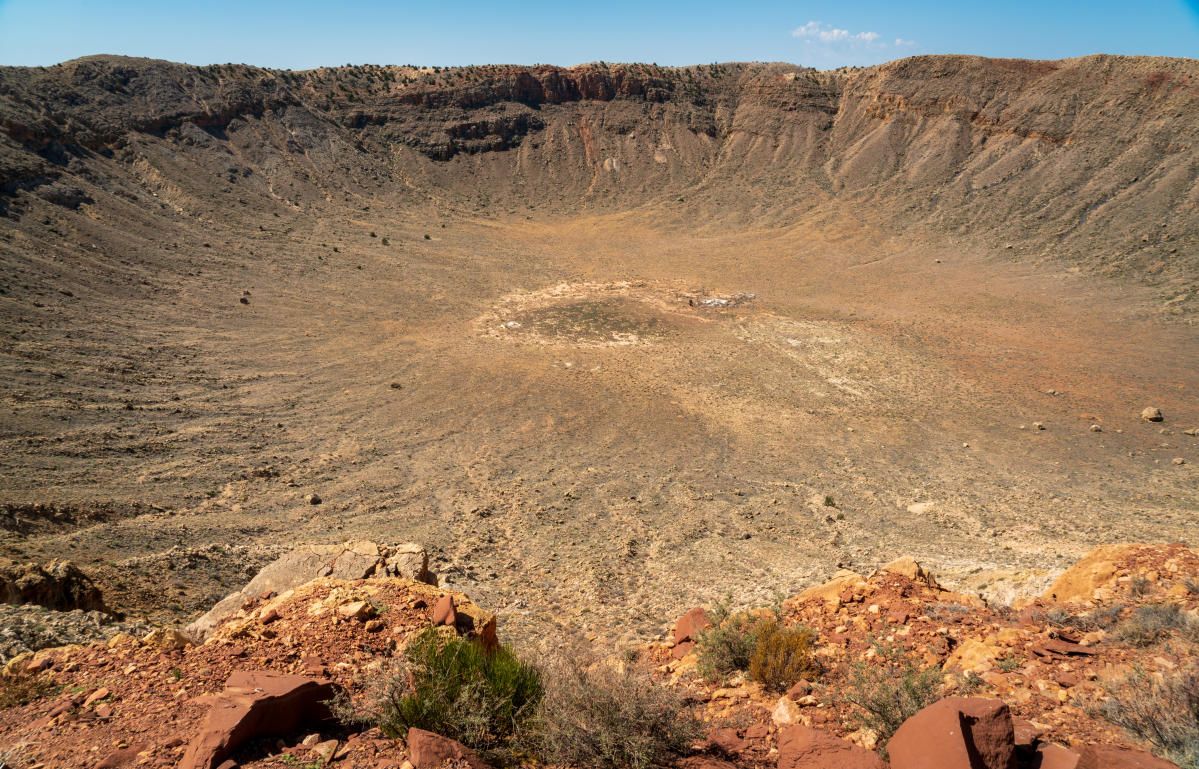
A team of researchers in Canada say they have discovered two new minerals – and potentially a third – after analysing a slice of a 15-tonne meteorite that landed in east Africa.
Researchers discover two new minerals on meteorite grounded in Somalia
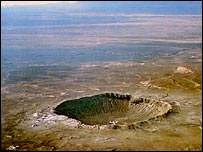
The meteorite, the ninth largest recorded at over 2 metres wide, was unearthed in Somalia in 2020, although local camel herders say it was well known to them for generations and named Nightfall in their songs and poems.
Western scientists, however, dubbed the extraterrestrial rock El Ali because it was found near the town of El Ali, in the Hiiraan region.
A 70-gram slice of the iron-based meteorite was sent to the University of Alberta’s meteorite collection for classification.
The meteorite was found near the town of El Ali in Somalia.
The meteorite was found near the town of El Ali in Somalia. Photograph: Courtesy of Global Resources Dr Chris Herd, a professor in the department of earth and atmospheric sciences and the curator of the collection, said that while he was classifying the rock he noticed “unusual” minerals. Herd asked Andrew Locock,
the head of the university’s electron microprobe laboratory, to investigate.“The very first day he did some analyses, he said, ‘You’ve got at least two new minerals in there’,” said Herd. “That was phenomenal.
Most of the time it takes a lot more work than that to say there’s a new mineral.”Similar minerals had been synthetically created in a lab in the 1980s but never recorded as appearing in nature, Herd said, adding that these new minerals could help understand how “nature’s laboratory” works and may have as yet unknown real-world uses.
A third potentially new mineral is being analysed.A sample of the meteorite.A sample of the meteorite.
Photograph: Courtesy of University of Alberta Meteorite Collection“I never thought I’d be involved in describing brand new minerals just by virtue of working on a meteorite,” said Herd. “That’s what makes this exciting: in this particular meteorite you have two officially described minerals that are new to science.” They have been named elaliite,
after the location of the meteorite, and elkinstantonite, after Lindy Elkins-Tanton, principal investigator of Nasa’s upcoming Psyche mission that aims to send a spacecraft to a metal-rich asteroid.“Lindy has done a lot of work on how the cores of planets form, how these iron nickel cores form, and the closest analogue we have are iron meteorites. So it made sense to name a mineral after her and recognise her contributions to science,” Herd said.
University of Alberta scientists would like to examine other samples from the same meteorite but Herd said there were reports that it had been removed to China. Meteorites are often bought and sold on international markets.
I hope you appreciated this article. Before you move on, I was hoping you would consider taking the step of supporting the Guardian’s journalism.
From Elon Musk to Rupert Murdoch, a small number of billionaire owners have a powerful hold on so much of the information that reaches the public about what’s happening in the world. The Guardian is different. We have no billionaire owner or shareholders to consider.
Our journalism is produced to serve the public interest – not profit motives.And we avoid the trap that befalls much US media – the tendency, born of a desire to please all sides, to engage in false equivalence in the name of neutrality.
While fairness guides everything we do, we know there is a right and a wrong position in the fight against racism and for reproductive justice.
When we report on issues like the climate crisis, we’re not afraid to name who is responsible. And as a global news organization, we’re able to provide a fresh, outsider perspective on US politics – one so often missing from the insular American media bubble.
Author: Ben Okri
Author: Ben Okri
Ben Okri
Ben Okri is a renowned novelist and poet whose written works defy definition. He is often termed post-modern, yet his seamless interweaving of the spirit world into his stories belies this genre. The author also rejects claims that his work falls into the ‘magical realism’ category, seeing his writing not as a venture into the realm of the fantastic but instead a reflection of an upbringing wherein myths, ancestors and spirits were an intrinsic component. “Everyone’s reality is different,” he once said. His most famous work is The Famished Road (1991), forming part of a trilogy with Songs of Enchantment and Infinite Riches. It chronicle the journeys of Azaro, a spirit-child
The paragraph discusses Russia’s efforts to strengthen its military and economic presence in Africa, with a focus on advancing its strategic goals, projecting influence, and supplanting the West. It details high-level Russian officials’ visits to African countries, highlighting the intent to strengthen military cooperation, expand economic engagement, pursue nuclear energy and agricultural cooperation, and increase … Continue reading Russia’s Strategic Expansion in Africa: High-Level Officials’ Agenda→
Somaliland, historically, the area now comprising Somalia and Djibouti. The name is also used to refer to the Republic of Somaliland, a self-declared independent country in the Horn of Africa Rep. Ilhan Omar stated in a speech on Jan. 27 in Minneapolis that she would leverage her influence to block a potential agreement between Ethiopia … Continue reading Somaliland is the newest country in Africa,→
Country music has a rich history that reflects the development of Africa, stemming from traditional African sounds and expanding into diverse subgenres that continue to enthrall audiences. Additionally, it’s common to experience homesickness upon returning from breaks, signifying a strong attachment to loved ones, and the process of adjusting to a new environment may take … Continue reading I’m a Refugee, I lost my Country→








 All Africa